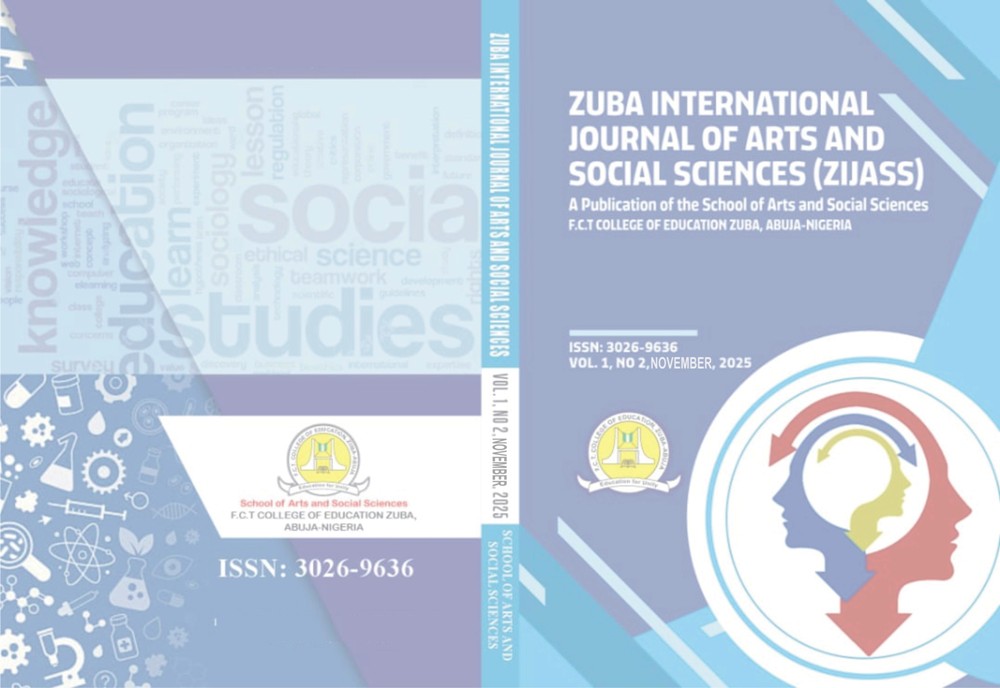
ZUBA INTERNATIONAL JOURNAL OF ARTS AND SOCIAL SCIENCES (ZIJASS)

A peer-reviewed journal of the School of Arts and Social Sciences,

F.C.T College of Education Zuba, Abuja – Nigeria.

ISSN: 3026-9636   |   Vol. 1, No. 2   |   November, 2025

Zuba International Journal of Arts and Social Sciences (ZIJASS) front cover, Vol. 1 No. 2, November 2025

Vol. 1, No. 2, November 2025   |   School of Arts and Social Sciences, F.C.T COE Zuba

Current Issue – Vol. 1, No. 2 (November 2025)

This issue of ZIJASS explores contemporary themes in arts, social sciences, education, technology and society, featuring contributions from scholars across Nigeria and beyond.

About the Journal

ZUBA INTERNATIONAL JOURNAL OF ARTS AND SOCIAL SCIENCES (ZIJASS) is a peer-reviewed publication dedicated to advancing scholarly discourse and research in the fields of Arts, Humanities and Social Sciences. It provides a platform for academics, educators and researchers to share innovative ideas, empirical findings and theoretical perspectives that contribute to knowledge development and national transformation.

Published by:
School of Arts and Social Sciences,
FCT College of Education, Zuba, Abuja - Nigeria.

Editorial Board

Editorial Board Members

  • Dr. Amina Mohammed Tijanni – Editor in Chief
  • Dr. Habib Babajo – Corresponding Editor
  • Dr. Stephen Maren – Secretary
  • Dr. Zakariah Tinimu T. – Member
  • Dr. Agnes Philip – Member
  • Dr. Umar Ahmed Ibrahim – Member
  • Dr. Safiya Jika – Member
  • Dr. Ifeoma O. E – Member

Journal Details

Journal Title:
Zuba International Journal of Arts and Social Sciences (ZIJASS)

Abbreviation: ZIJASS

ISSN: 3026-9636

Frequency: Volume 1, Number 2 – November 2025

Publisher: School of Arts and Social Sciences,
FCT College of Education, Zuba, Abuja – Nigeria.

Editorial

Social sciences have always been the cornerstone of understanding society, governance, and human interaction. Yet, in the 21st century, the methods of teaching these vital subjects must evolve to reflect the world our students inhabit. The traditional model of lecture, textbook, and test is no longer adequate to prepare students for the complexities of a globally connected, digitally driven age.

The integration of digital technology is no longer a luxury but a fundamental necessity for effective social sciences education. Emerging tools transform the classroom from a passive listening post into a dynamic laboratory for inquiry. Learners move from being mere recipients of facts to becoming active participants in historical analysis, geographic exploration and economic modelling.

In an era of information overload and misinformation, the social sciences classroom also carries a critical mandate: fostering digital literacy and critical thinking. The thoughtful application of digital technologies is pivotal for creating a generation of engaged, critical and empathetic citizens who can navigate the past, understand the present and shape the future.